St Peter's CE Primary School
Behaviour at St Peter's
Intent
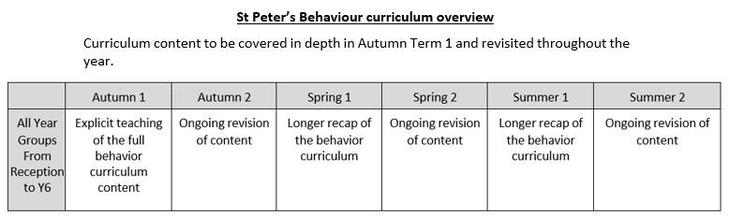
At St Peter’s CE Primary, we develop children’s character through our behaviour curriculum. In order to build character, we define the behaviours and routines that we expect children to demonstrate. We want to support our pupils to grow into adults who are polite, respectful, grateful and who always consider others. We believe that as pupils practise these behaviours, over time they become automatic routines that positively shape how they feel about themselves and how other people perceive them.
By nurturing these foundational behaviours, we create a supportive environment that fosters both personal growth and academic success, ensuring that our children are not only prepared for the challenges of today but also equipped to be responsible and considerate members of tomorrow's society.
Aims:
- To ensure behaviour is of the highest standard so that all children can achieve the best academic outcomes
- To ensure that all members of the school community feel safe
- To ensure a strong culture of character development that teaches children to be respectful, responsible and safe
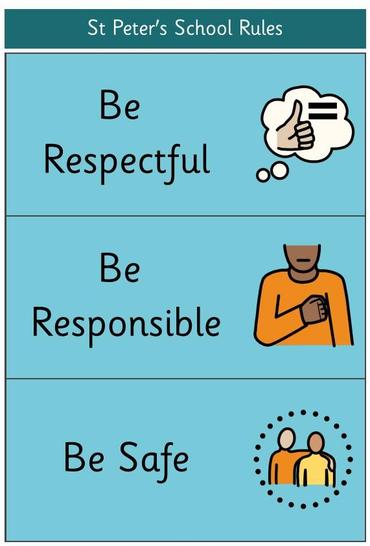
St Peter’s School Rules
- Be respectful- Article 12 You have the right to give your opinion, and for adults to listen and take it seriously
- Be responsible- Article 29 your education should help you use and develop your talents and abilities. It should also help you to live peacefully, protect the environment and respect other people
- Be safe- Article 19 you have the right to be protected from being hurt and mistreated, in body or mind
Implementation
To help children succeed we teach behaviour – not tell.
Below is a checklist that all staff will use when teaching children how to behave.
- Leaders and staff teach behaviour explicitly
- staff use consistent language
- staff demonstrate the behaviour/ role models we seek
- staff correct/ challenge poor behaviour
- Routines are repeated constantly
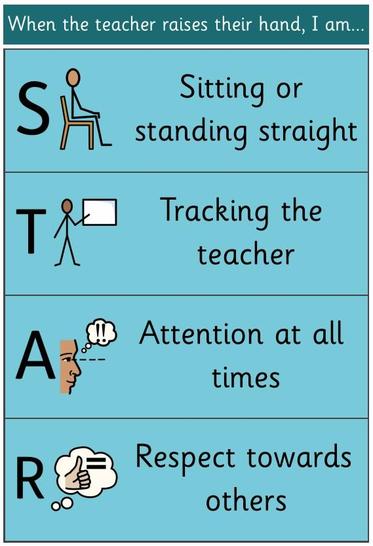
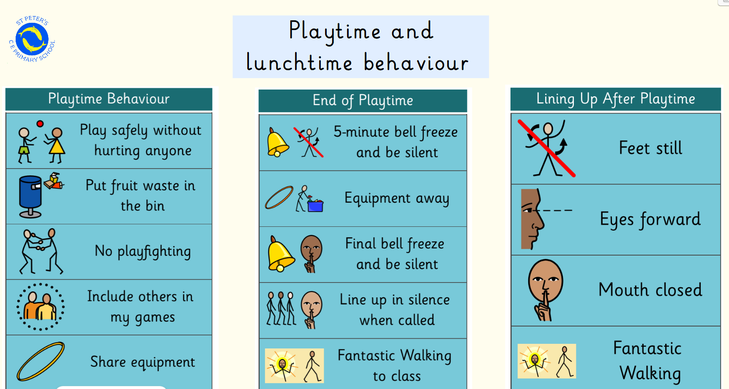
Examples of our routines
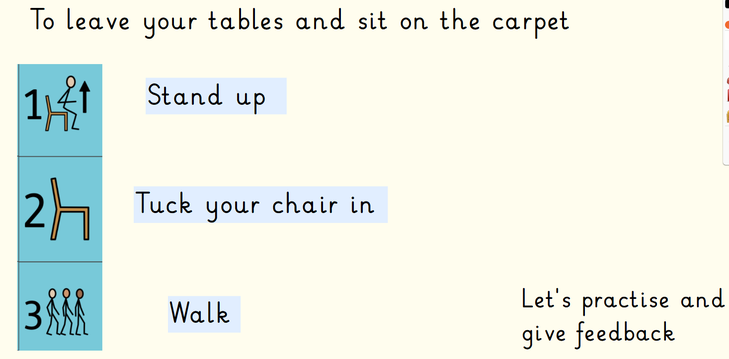
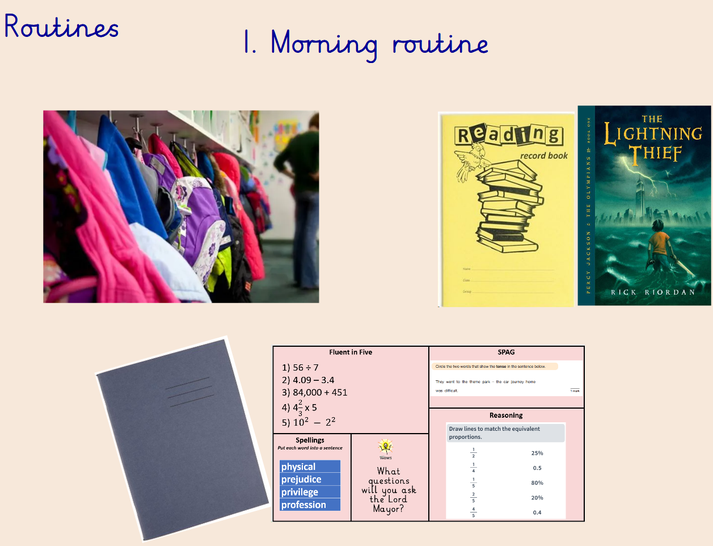
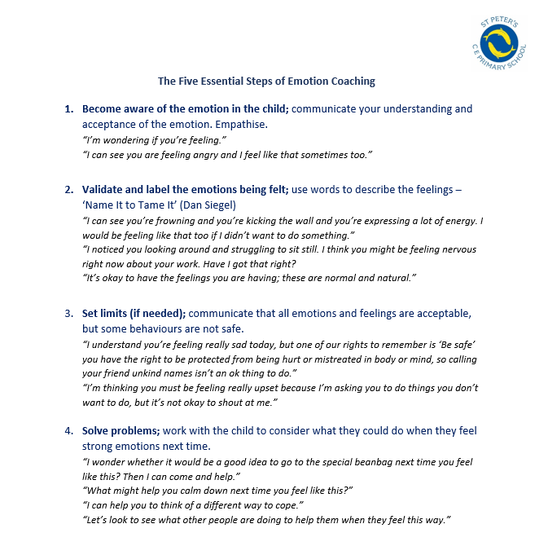
All adults use the principles of Emotion Coaching and take the four-step approach:
1. Become aware of the emotion in the child; communicate your understanding and acceptance of the emotion.
2. Validate and label the emotions being felt; use words to describe the feelings – ‘Name It to Tame It’ (Dan Siegel)
3. Set limits (if needed); communicate that all emotions and feelings are acceptable, but some behaviours are not safe.
4. Solve problems; work with the child to consider what they could do when they feel strong emotions next time.
A Trauma Informed School (TiS):
TiS is a dynamic, developmental approach to working with children that supports their emotional and social wellbeing. It is based on the latest research in neuroscience, attachment theory and child development.
We recognise that it is important for adults to understand where a child is in terms of their mental and emotional health and this approach supports staff with how to differentiate their relationship with children in order to support their development. All the adults at St Peter’s aim to develop attuned relationships with our pupils so that we can provide a safe haven for them to express their emotions. All feelings are considered normal, but need to be regulated and expressed constructively.
Parental Involvement
Continual and positive contact with parents is implicit to the successful implementation of this policy. Contact should emphasise positives to build effective relationships and connections. In cases where detailed and regular communication is required then the class teacher will ensure that the behaviour of the pupil in question will be carefully monitored in order that accurate and objective information can be conveyed to parents.
Promoting Good Behaviour
We do not reward children for following rules. Instead, we focus on everyone behaving and demonstrating good conduct as it is the right thing to do and contributes to us creating a wonderful learning environment.
We have many positive reinforcements that help steer children away from poor behaviour and towards good behaviour. These also help to develop self-confidence, which in turn promotes learning.
Graduated response
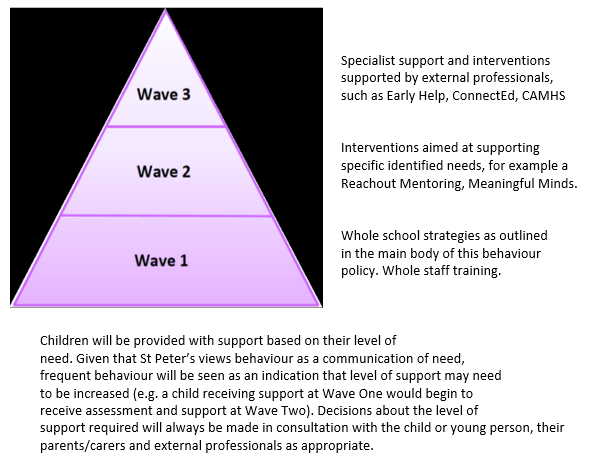
Children/young people have a wide range of individual needs which change over time. As such, children/young people require a flexible approach within an overall structure of consistency. Whilst we envisage that our Wave One behavioural approach (please see below) will be effective for the majority of children/young people at St Peter’s, some children/young people will require extra support in order for us to ensure an equitable school environment. A graduated response to behaviour allows staff to support children/young people according to their current level of need.
The pyramid below provides some examples of support offered at each wave of our graduated response: